A Guide to Automated Website Optimization
Website optimization involves a lot of moving pieces. Teams have to understand visitor behavior, uncover opportunities, decide what deserves attention, plan improvements, test ideas, and carry what they learn into whatever comes next.
Automation and AI can help connect more of that work. Learn how automated website optimization can reduce manual effort, create a more efficient optimization process, and help your team keep improving without putting your website on autopilot.
Why is Website Optimization Still So Manual?
Improving a website sounds simple enough. Find something that isn’t working, make it better, and see what happens. In practice, optimization involves a lot more work behind the scenes.
Teams have to understand how visitors are using the site, sort through behavioral and performance data, identify potential opportunities, decide what deserves attention, plan improvements, coordinate experiments, review results, and determine what to do next.
The challenge isn’t any one of those tasks. It’s keeping the entire website optimization process moving. Insights may live in different tools, decisions depend on manual analysis, and every new optimization effort can feel like starting the process over again.
Website optimization automation can reduce some of that workload. By using AI and automation for repetitive analysis, pattern recognition, opportunity discovery, and other time-consuming parts of the process, teams can spend less time managing optimization and more time deciding how to improve the experience.
What Is Automated Website Optimization?
Automated website optimization is the use of AI and automation to reduce the manual work involved in improving a website over time. It can help teams analyze available data, uncover patterns in visitor behavior, identify and prioritize opportunities, plan what to explore next, and connect what they learn from one optimization effort to the next.
The goal isn’t to automate every step. It’s to make the website optimization workflow more efficient by letting technology handle some of the repetitive analysis and organizational work that can slow teams down.
A/B testing can be an important part of that process, but it’s only one piece. Effective optimization also depends on understanding visitor behavior, deciding which opportunities matter, applying business and brand context, and learning from the results of previous changes and experiments.
That combination of automation and human judgment can help teams move away from isolated optimization projects and toward a more continuous website optimization process.
Automated Website Optimization Can Help With
- Analyzing available signals
- Recognizing patterns
- Surfacing opportunities
- Reducing repetitive work
- Connecting learnings over time
Your Team Brings
- Strategy and priorities
- Business context
- Brand judgment
- Creative execution
- Final decisions
Automation makes the process more efficient. Human judgment determines where it leads.
How can AI automate website optimization?
AI can help automate time-consuming parts of website optimization such as analyzing available website and behavioral signals, recognizing patterns, surfacing potential opportunities, and helping teams turn those insights into actionable next steps. Your team still provides the strategy, context, creative execution, and decisions about what gets tested or changed.
A/B Testing Is Only One Part of Website Optimization
A/B testing is one of the most useful ways to learn whether a change improves website performance, but the test itself is only one part of the optimization process.
Automated website optimization isn’t about automating more tests. It’s about removing unnecessary manual work across the entire optimization process.
Before an experiment ever runs, your team has to understand how visitors are using the website, identify potential friction or opportunities, decide what deserves attention, and determine what might be worth testing. After the experiment ends, someone still needs to interpret the results, capture what was learned, and decide how those insights should influence what happens next.
When those activities are treated as separate projects, website conversion optimization can become difficult to sustain. A more connected process helps teams carry insights forward.

The opportunity for website optimization automation exists across this larger process. AI and automation can help teams work through information faster, recognize patterns, organize potential opportunities, and reduce some of the repetitive work between insight and action.
That doesn’t mean every step should be automated. Strategy, prioritization, creative decisions, and business context still require human judgment. The goal is to make the process surrounding those decisions more efficient.
Does automated website optimization replace A/B testing?
No. A/B testing remains an important way to determine whether a proposed change improves performance with real visitors. Automated website optimization can make the broader process around experimentation more efficient, from analyzing signals and identifying opportunities to carrying learnings forward after a test.
How does automated website optimization work?
Automated website optimization works by using AI and automation to reduce manual effort across parts of the broader optimization process. That can include analyzing website and behavioral information, recognizing patterns, organizing opportunities, supporting planning, and carrying learnings forward. Testing remains one part of the process, while your team provides the strategy, creative execution, and decisions that determine what moves forward.
What Parts of Website Optimization Can Be Automated?
Not every optimization task needs automation. The best opportunities are often the parts of the process that require teams to sort through large amounts of information, look for patterns, organize what they find, and turn those findings into something useful.
AI and automation can help reduce that workload without taking over the strategic and creative decisions that make optimization valuable. The result is less time spent managing the process and more time focused on deciding what deserves attention.
Analyze More Information, Faster
Website optimization can involve behavioral data, performance metrics, previous experiment results, and information about the website itself. Manually reviewing all of those signals takes time, especially when they live in different places.
AI can help synthesize available information and surface patterns that may be worth a closer look, giving teams a more manageable starting point for their analysis.
Surface Opportunities Worth Exploring
Finding a pattern is different from knowing what to do with it. Automation can help connect website signals to potential areas of friction, engagement issues, or opportunities for improvement.
Those opportunities still need to be evaluated against your goals and business context, but your team doesn't have to begin every optimization effort with a blank page.
Reduce the Work Between Insight and Action
An insight is only useful if your team can do something with it. There can be a surprising amount of manual work between recognizing an opportunity and having a clear next step.
AI can help organize findings, develop recommendations, and support experiment planning, shortening the distance between “we noticed something” and “here's what we could explore next.”
Carry Learnings Forward
Optimization becomes more valuable when what you learn today helps inform what you investigate tomorrow.
Previous results, behavioral patterns, and new website signals can provide additional context for future optimization decisions. Automation can help teams make better use of that growing body of information instead of treating every project as an isolated event.
Maintain a More Consistent Optimization Cadence
One of the hardest parts of optimization isn't knowing that a website could improve. It's finding the time to continuously look for those improvements.
By reducing repetitive analysis and planning work, automated CRO can make it easier for teams, especially smaller ones, to maintain a more consistent optimization process without continually adding more manual work.
What website optimization tasks should be automated?
The best candidates are usually repetitive, data-heavy tasks where technology can help teams work more efficiently, such as analyzing available signals, recognizing patterns, organizing opportunities, and supporting optimization planning. Strategy, prioritization, creative execution, and decisions about what gets tested or changed are better kept in human hands.
Automation works best when it removes friction from the optimization process, not judgment from the decisions.
What Should Stay Human?
Automation can make website optimization more efficient, but efficiency isn’t the same as handing over every decision. Some parts of optimization depend on context, creativity, and judgment that your team is better equipped to provide.
AI can help surface information and move the process forward. Your team decides what matters, what makes sense for the business, and what ultimately happens on the website.
AI & Automation Can Support
- Analyzing available signals
- Recognizing patterns
- Surfacing potential opportunities
- Supporting optimization planning
Your Team Should Own
- Setting strategy and priorities
- Applying business & brand context
- Making creative decisions
- Deciding what gets tested
- Interpreting results in context
- Deciding what changes
Can AI automatically optimize my website?
AI can automate parts of the website optimization process, but that doesn't mean it needs to operate your website autonomously. With Bluvia A/B Testing, AI Optimize can help analyze available signals, identify opportunities, and create recommended experiments. Your team reviews those experiments, builds the variations, decides what gets tested, and determines what ultimately changes on the live website.
Automate the work that slows you down. Keep the decisions that need your judgment.
Build an Optimization System, Not a Series of Projects
Website optimization often happens in pieces. Behavioral insights live in one tool, performance data in another, experiments happen somewhere else, and the results may end up in a spreadsheet or report that rarely gets revisited.
That fragmentation creates more than extra work. It makes it harder to connect what you’re learning today with what your team should investigate tomorrow. Each new optimization effort can start to feel like another standalone project instead of the next step in an ongoing process.
A more connected approach brings those activities together. Insights help inform priorities, priorities lead to action, experiments create new evidence, and those learnings become part of what your team considers next.

Website optimization automation can help reduce the manual work between these stages, making it easier to move information from insight to action and carry what you learn forward.
The goal isn’t to create an autonomous optimization loop. Your team still determines priorities, makes creative and strategic decisions, and decides what gets tested or changed. Automation helps keep the process connected so those decisions can be made with better context.
How can I automate my website optimization process?
Start by looking for repetitive work and disconnected handoffs across your existing optimization workflow. AI and automation can help with tasks such as analyzing available signals, surfacing patterns, organizing opportunities, and carrying insights forward. The goal is to connect more of the process while keeping strategy, creative execution, and final decisions with your team.
From One-Off CRO to Continuous Website Optimization
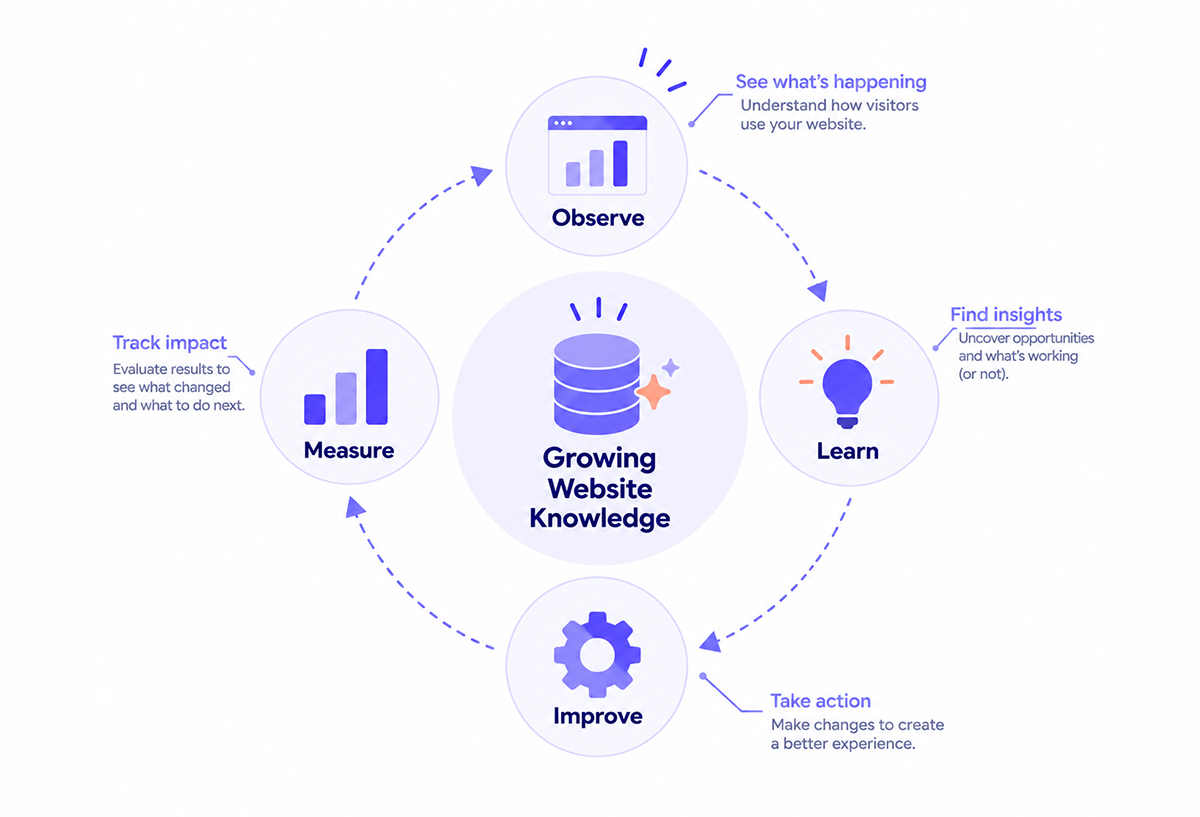
Website optimization is easy to treat like a series of individual projects. Find a problem, make an improvement, measure what happened, and move on. The trouble is that much of what you learn along the way can get left behind.
Continuous website optimization takes a longer view. Instead of treating each analysis, experiment, or improvement as an isolated event, teams use what they learn to build a stronger understanding of their visitors and website over time.
The more connected that process becomes, the less often your team has to start from scratch.
Let Each Optimization Effort Add to What You Know
Every optimization effort creates information. Behavioral patterns can reveal where visitors struggle or engage. Experiments can confirm an assumption, challenge it, or uncover something unexpected. Even a test that doesn’t produce a clear winner can give your team useful context for what to investigate next.
When those learnings remain connected to ongoing website and behavioral signals, they can provide a better starting point for future decisions. AI and automation can help teams work with that growing body of information, making continuous website optimization more manageable without requiring constant manual analysis.
The goal isn’t to generate an endless stream of changes or experiments. It’s to create an optimization process that gets more informed over time.
What is continuous website optimization?
Continuous website optimization is an ongoing approach to improving a website using behavioral insights, performance data, experimentation, and previous learnings to inform future decisions. Rather than treating optimization as a series of unrelated projects, teams build on what they learn over time and continually look for meaningful opportunities to improve the experience.
Better Recommendations Start With Better Context
AI is more useful when it has context about what visitors are doing and the website experience they’re interacting with. Instead of generating generic testing ideas, AI uses available behavioral and website signals to identify patterns and opportunities worth exploring specific to your website.
For WordPress teams, that context can include heatmap, scroll, and click data, along with information about the site’s layout, theme, page builder, and certain page information when enabled. Together, those signals help AI move from here’s what visitors are doing to here’s something worth exploring through a test.
Visitor Behavior
- Heatmap Data — See where attention is concentrated and where it may drop off.
- Scroll Behavior — Understand how far visitors move through a page and what they may never reach.
- Click Data — See which elements attract interaction and which important elements may be overlooked.
WordPress Site Content
- Site Layout & Theme — Provides context about how the experience is structured.
- Page Builder — Helps AI understand how pages are built, including builders such as Elementor.
- Page Information — Certain page information can provide additional context about what kinds of experiments may be possible when enabled.
With AI Optimize, Bluvia A/B Testing can use available behavioral signals and WordPress site context to help develop more relevant experiment recommendations. You control which optional site information is included, so AI can have useful context without taking control of your optimization decisions.
How does AI identify A/B testing opportunities?
AI can analyze available behavioral signals and website context to look for patterns that may point to friction, missed engagement, or other opportunities for improvement. Those signals can then help inform AI experiment recommendations for changes that may be worth testing rather than assuming a change will improve performance.
Putting Website Optimization Automation to Work
The value of automation isn’t limited to doing one optimization task faster. It can help remove bottlenecks across the process, especially when teams have more data, opportunities, and ideas than they have time to investigate.
Here are three situations where automated conversion optimization can make the broader optimization process easier to manage.
When You Have More Information Than Time
Heatmaps, website analytics, behavioral signals, and previous results can provide plenty of information about what visitors are doing. The challenge is finding the time to review everything and recognize the patterns that deserve attention.
AI can help analyze available signals, surface potential areas to investigate, and organize what your team is learning. That gives you a more focused starting point without requiring someone to manually sift through every source of information first.
Reducing that repetitive analysis can also make automated conversion rate optimization more practical for smaller teams that want to maintain a consistent optimization program without continually adding more manual work.
When You Don’t Know What Deserves Attention Next
Sometimes the challenge isn't finding optimization ideas. It's deciding which ones are worth pursuing.
Your team may have a growing list of potential improvements, or you may simply know that website performance could be stronger without having an obvious place to start. AI website optimization and AI conversion optimization can help surface and organize potential opportunities based on available website and behavioral context.
Automation doesn't make the prioritization decision for you. It gives your team better information to work with when considering potential impact, business priorities, available resources, and what deserves further investigation.
When Your Optimization Process Is Fragmented
An insight found in one platform may need to be documented somewhere else, discussed with the team, turned into an experiment in another tool, and eventually connected back to the results.
Those handoffs create additional work and make it easier to lose the context behind why an opportunity was explored in the first place.
Website optimization automation can help connect more of that process, reducing the manual work between understanding what is happening, deciding what to explore, testing potential improvements, and carrying what you learn forward.
How can AI make conversion optimization more efficient?
AI can make conversion optimization more efficient by helping teams analyze available information, recognize patterns, surface potential opportunities, and reduce repetitive work between insight and action. It doesn't eliminate the need for strategy or human judgment, but it can give teams a stronger starting point and more time to focus on the decisions that matter.
Bringing Automated Website Optimization Into WordPress
WordPress makes it possible to build and manage almost every part of a website, but optimization often happens outside of it. Analytics may live in one platform, behavioral insights in another, experiments in another, and optimization ideas may be tracked in spreadsheets, documents, or project management tools.
Every additional platform creates another handoff. Someone has to find the insight, preserve the context, decide what to do with it, move that idea into the next tool, and eventually connect the results back to the original opportunity.
For teams trying to maintain a consistent WordPress website optimization program, those handoffs can create just as much friction as the optimization work itself.
Bring More of the Process Closer Together
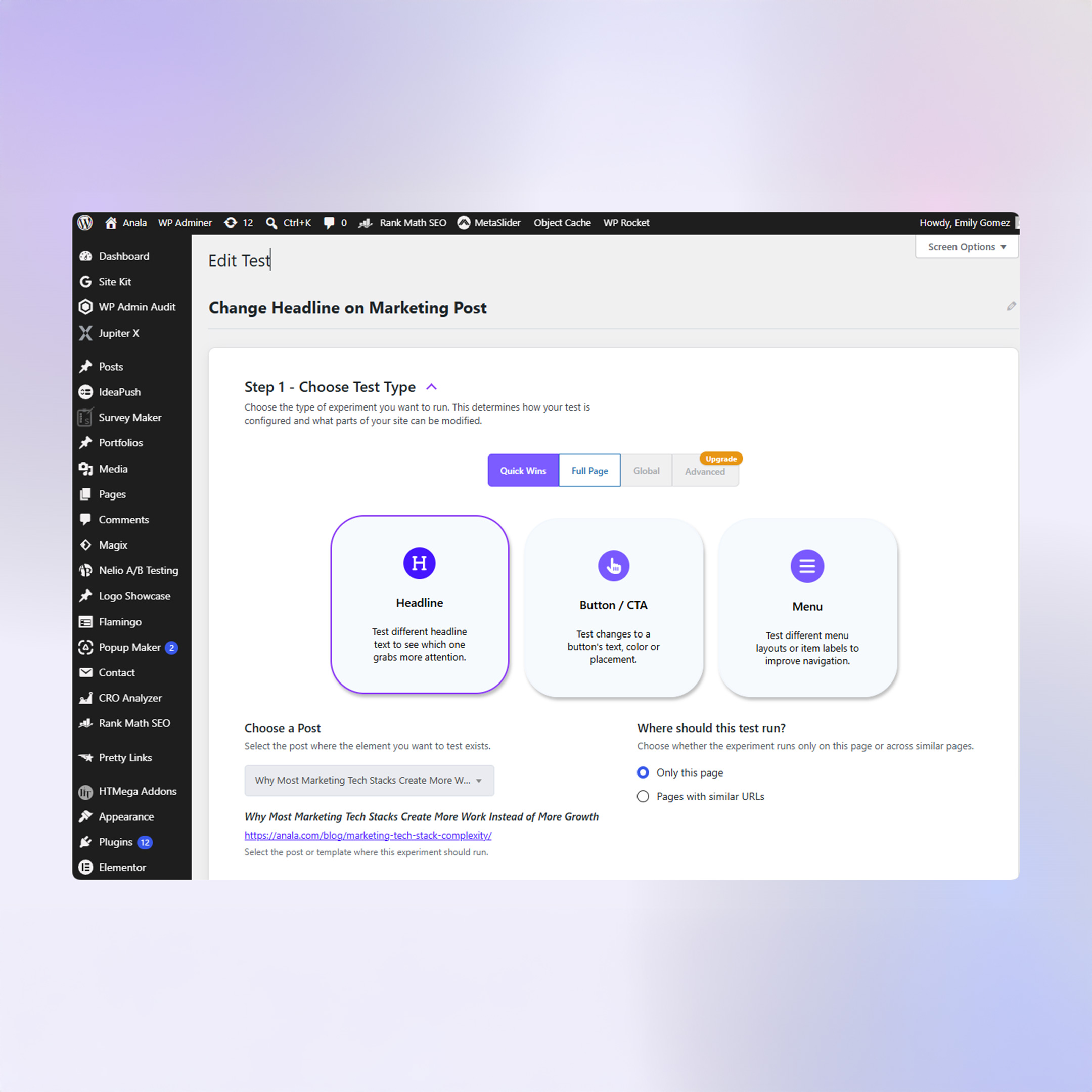
An AI website optimization tool built for WordPress can reduce some of that fragmentation by bringing more of the optimization process closer to the website.
Bluvia A/B Testing combines behavioral insights and experimentation within WordPress, while AI Optimize adds AI-assisted analysis, opportunity identification, and experiment creation. Instead of treating each of those activities as a separate workflow, teams can move more naturally from understanding visitor behavior to deciding what deserves attention.
That doesn’t mean every optimization activity needs to happen in one place. The advantage is reducing unnecessary handoffs where a more connected workflow can make the process faster and easier to maintain.
Website Context Matters, Too
Website optimization with AI becomes more useful when recommendations are informed by the website they’re intended to improve.
Depending on the settings enabled by the site owner, AI Optimize can consider behavioral activity along with relevant information about the WordPress experience itself. That additional context can help surface opportunities grounded in how visitors are interacting with the site and how the page is built, rather than relying on a generic AI prompt alone.
Site owners control certain settings that determine what information is available to AI Optimize.
Fewer handoffs. More connected optimization.
What Should You Look for in an AI Website Optimization Tool?
Automation is only useful if it makes optimization easier to manage and leads to better-informed decisions. Adding another tool that creates more data, more handoffs, or more work defeats the purpose.
When evaluating technology for automated website optimization, look beyond whether it uses AI. Consider how well it fits into the broader optimization process, what information it can work with, how easily insights can become action, and how much control your team maintains.
Real Website Context
Does it reduce the number of tools and manual transfers involved in moving from insight to action?
Prioritization Support
Does it help make a growing list of signals and opportunities easier to evaluate and manage?
Less Repetitive Analysis
Does it reduce the manual work required to continually review website and behavioral information?
Connected Optimization History
Can previous insights and results provide useful context for future optimization work?
Human-Led Strategy
Does automation support your team's priorities rather than determine them?
WordPress-Native Workflows
For WordPress teams, how much of the optimization process can happen close to the website itself?
What is the best AI website optimization tool?
There isn't one answer for every website. Look for an AI website optimization tool that works with meaningful website and behavioral context, reduces manual optimization work, turns insights into actionable opportunities, supports real experimentation, and keeps your team in control of what gets tested and changed. For WordPress teams, a WordPress-native approach can also reduce the handoffs between the website, insights, and experimentation.
The right platform doesn’t just automate individual tasks. It helps make the entire optimization process easier to manage.
How Bluvia A/B Testing Connects the Optimization Workflow
A more efficient optimization process depends on keeping insights, experimentation, and learning connected. Bluvia A/B Testing brings more of that work into WordPress so teams can spend less time moving between tools and more time using what they learn to improve the website.
Behavioral insights help reveal how visitors are interacting with the experience. Experimentation gives teams a way to test potential improvements with real visitors. With the AI Optimize plan, AI-assisted analysis and experiment creation can reduce more of the manual work between understanding what’s happening and deciding what to explore next.
Together, those capabilities support a more connected approach to AI-powered website optimization while keeping your team in control of the decisions.
Behavioral Insights
Heatmaps and other behavioral insights can help your team see how visitors interact with the website, including where they click, how far they scroll, and where there may be opportunities worth investigating.
Instead of relying only on assumptions about the experience, your team has real visitor behavior to inform its optimization decisions.
Explore More
Reduce the Work Between Insight and Experiment
AI Optimize can use available website and behavioral context to help identify potential opportunities and create experiments with recommendations for what could be tested.
Your team reviews the AI-created experiment, builds the recommended variations, and decides whether it moves forward. For a deeper look at how AI supports this part of the process, visit our AI A/B Testing for WordPress Guide.
Explore More
Test, Learn, and Keep Improving
A/B testing lets your team evaluate ideas with real visitors rather than treating a recommendation as proof that a change will work.
Those results add to what you know about your visitors and website, giving your team more context to consider as it looks for future optimization opportunities.
Explore More
Automated Website Optimization FAQs
Can automated website optimization work with WordPress?
Yes. Automated website optimization can work with WordPress, and a WordPress-native approach can reduce some of the handoffs between behavioral insights, experimentation, and the website itself. Bluvia A/B Testing brings behavioral insights and experimentation into WordPress, while AI Optimize adds AI-assisted analysis, opportunity identification, and experiment creation.
What’s the difference between automated website optimization and AI A/B testing?
Automated website optimization describes the broader process of using AI and automation to make website optimization more efficient, from analyzing signals and identifying opportunities to testing improvements and carrying learnings forward.
AI A/B testing focuses more specifically on using AI to support experimentation. A/B testing can be an important part of automated website optimization, but it is only one part of the larger optimization process.
Does automated conversion optimization mean AI makes the decisions?
Can automated website optimization help small teams?
Yes. Smaller teams may benefit from automation because they often have limited time to analyze behavioral data, identify optimization opportunities, plan experiments, and maintain a consistent optimization program. Reducing repetitive analysis and planning work can make ongoing website conversion optimization more manageable without requiring a larger CRO team. Yes. Bluvia A/B Testing keeps human review within the optimization process. Your team reviews AI-recommended experiments before they run and reviews winning changes before deciding whether they should be applied to the live website.
What data can AI use for website optimization?
The available data depends on the platform and its settings. AI-powered conversion optimization can use website and behavioral context to help identify patterns and potential opportunities.
With AI Optimize, available context can include heatmap activity such as clicks and scrolling, along with information about your WordPress theme, site layout, page builder, and certain page information when enabled. Site owners maintain control over certain settings that determine what information is available to AI Optimize.
Can website optimization automation replace a CRO team or agency?
No. Automation can reduce repetitive analysis, help surface opportunities, and make an existing website optimization process more efficient. A CRO team, consultant, or agency brings strategy, business context, creative thinking, prioritization, and expertise that automation doesn’t replace.
For some teams, automation may make it possible to handle more optimization work internally. For others, it can help an internal or external CRO team spend less time on repetitive tasks and more time on higher-value decisions.
Spend Less Time Managing Optimization. Spend More Time Improving It.
Website optimization doesn’t have to mean constantly starting over, sorting through disconnected data, or manually moving insights from one tool to the next.
With the AI Optimize plan, Bluvia A/B Testing helps bring behavioral insights, AI-assisted optimization, and experimentation into a more connected WordPress workflow, so your team can reduce manual work while staying in control of what gets tested and changed.
Start with a 14-day free trial.