
Most A/B Tests Fail Before They Launch
Most A/B tests fail because teams start with assumptions instead of evidence. They skip visitor behavior analysis, test random ideas, and struggle to create meaningful improvement.
This guide explains how modern WordPress teams use heatmaps, session recordings, and behavioral insights to build stronger hypotheses, run better experiments, and improve conversion rates over time.
The Real Problem With A/B Testing Isn’t the Tool
Most A/B testing programs don’t fail because teams chose the wrong tool. They fail because the experimentation process itself is broken.
Teams test ideas that were never grounded in visitor behavior. They launch experiments too large to isolate a meaningful variable. They stop tests before statistical significance is reached. They move on after a winner is declared without understanding why visitors responded differently in the first place.
Most experimentation programs also rely too heavily on conversion metrics alone. Teams see that a variation won, but never fully understand what behavioral patterns influenced the outcome. That makes future experiments harder to prioritize confidently.
The result is an experimentation program that looks active but produces inconsistent gains, fragmented learning, and declining organizational confidence over time.
The fix isn’t a new set of features. It’s a different approach to how experiments get analyzed, prioritized, launched, and learned from.
How does A/B testing work?
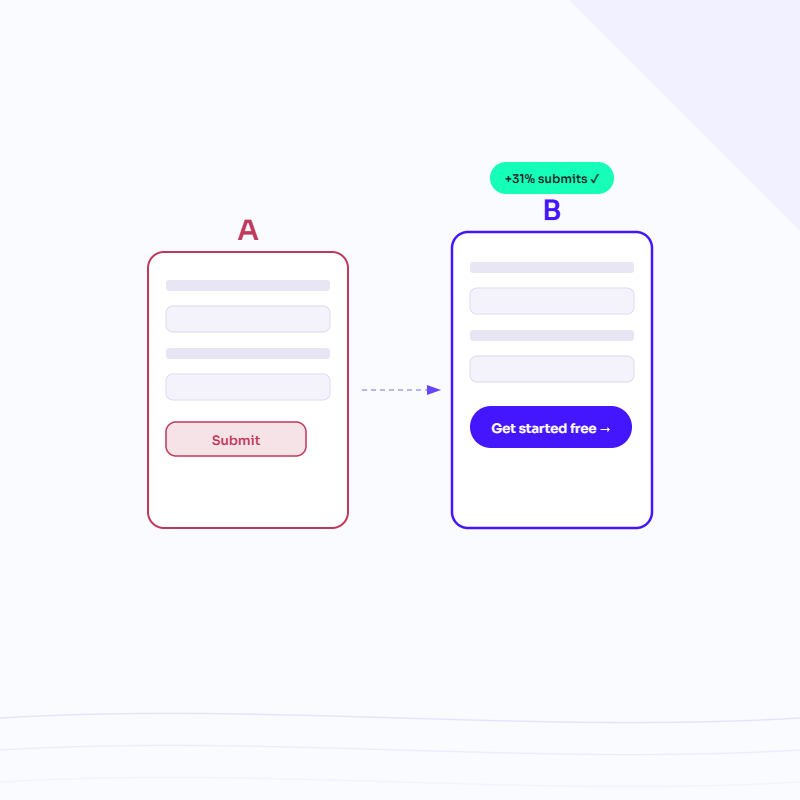
A/B testing compares two or more versions of a page element, layout, message, or experience to determine which drives stronger engagement or conversion outcomes.
Modern experimentation programs combine testing with visitor behavior analysis, heatmaps, session recordings, scroll behavior, and engagement analysis so teams understand not only what changed, but why visitors responded differently across experiments.
How High-Performing Teams Run Experiments
The strongest A/B testing programs follow a consistent pattern: analyze visitor behavior first, build evidence-based hypotheses, launch focused experiments, and use results to guide future optimization decisions instead of simply declaring a winner and moving on. Teams searching for how to do A/B testing effectively usually struggle less with the experiment itself and more with prioritization, behavioral analysis, and hypothesis creation.
Modern experimentation workflows require more than experiment creation alone. The strongest A/B testing for WordPress programs also rely on behavioral analysis, organized testing systems, and continuous optimization workflows teams can sustain over time.
Here’s what that process looks like in practice.

- 1 Analyze Visitor Behavior
Before building any experiment, gather evidence about how visitors interact with the page. Strong experiments begin with observed behavior rather than assumptions about what visitors want.
What to look for:
- Click Drop-off
- Dead Clicks
- Hesitation Patterns
- Repeated Navigation Behavior
- Scroll Abandonment
- Form Friction
In Bluvia A/B Testing: Teams can review heatmaps, session recordings, and behavioral data directly inside WordPress to gather evidence before deciding what deserves experimentation effort.
Example: Session recordings reveal visitors repeatedly abandoning a pricing page before reaching the CTA section.
- 2 Define a Specific Optimization Goal
Every experiment should connect to one measurable outcome. Vague goals create unclear learning.
Strong Goals Include:
- Increasing Demo Request Submissions
- Improving Add-to-cart Behavior
- Reducing Form Abandonment
- Increasing CTA Engagement
- Improving Pricing Page Interaction
- 3 Build a Behavior-Driven Hypothesis
Strong A/B testing hypotheses connect observed visitor behavior to a measurable prediction.
Recommended structure: “Because visitors [observed behavior], changing [specific element] will [expected outcome].”
Example: “Because visitors abandon the pricing page before reaching the CTA, shortening the page layout and moving pricing content higher will increase demo request submissions.”
Weak Experimentation Thinking
- Starts with opinions
- Test ideas because they “feel right”
- Focuses on what to change
- Launches experiments without a clear hypothesis
- Treats winning tests as isolated successes
- Relies primarily on conversion metrics
- Creates disconnected one-time tests
Strong Experimentation Approach
- Starts with observed visitor behavior
- Tests ideas supported by evidence
- Focuses on why visitors behave the way they do
- Builds hypotheses tied to measurable outcomes
- Uses results to guide future experiments
- Combines conversion metrics with behavioral insights
- Builds a repeatable experimentation process
Feature "Free"
- Unlimited tests
- Unlimited tests visits
- Unlimited test visits
- Multi-page testing
- Setup speed
- Self-maintained site
- Funnels & drop-off tracking
- Behavioral data (clicks, scrolls, engagement)
- Know why results happen
- WordPress native
- No-code setup
- Performance impact
- Pricing transparency
- Free trial
- Al Test suggestions
Bluvia
Nelio A/B Testing
- 1 Test concurrently
- 500 limit
High-performing experimentation programs don’t run more tests. They run better tests by connecting visitor behavior, hypothesis creation, experimentation, and learning into a repeatable process.
- 4 Create a Focused Variation
The best experiments isolate a clear variable. Large redesigns make it difficult to understand which change actually influenced visitor behavior.
Common High-Impact Test Types:
- CTA Placement
- Headline Messaging
- Form Structure
- Landing Page Layout
- Navigation Hierarchy
- Pricing Presentation
- Checkout Flow
In Bluvia A/B Testing: Launch variations directly inside WordPress without relying heavily on developer resources or external experimentation tools.
Example: Variation B shortens the pricing page layout and introduces a CTA section above the fold.
- 5 Launch, Monitor, and Measure
Track the primary conversion goal while monitoring visitor engagement patterns across both variations.
What to Watch
- Conversion Rate
- CTA Clicks
- Form Completion Behavior
- Add-to-cart Actions
- Scroll Depth
- Session Recordings
- Visitor Interaction Patterns
Behavioral signals often reveal optimization opportunities that conversion metrics alone fail to explain.
In Bluvia A/B Testing: Experiment metrics, heatmaps, session recordings, and visitor behavior analysis stay connected inside one experimentation workflow.
Example: Teams compare CTA engagement, scroll depth, and form completion rates across both pricing page layouts.
- 6 Learn Forward, Not Just Declare a Winner
Winning experiments should generate future hypotheses instead of becoming isolated one-time projects.
Questions Worth Asking:
- Why did the variation perform better?
- What behavioral patterns influenced the outcome?
- What should be tested next?
- What did session recordings reveal that metrics alone missed?
Example: The pricing page experiment reveals visitors respond more positively to simplified layouts. That leads to follow-on experiments testing navigation structure and CTA messaging across additional pages.
Questions High-Performing Teams Ask After Every Experiment:
- What did we learn about visitor behavior?
- What surprised us?
- Which assumptions were validated?
- Which assumptions were incorrect?
- What should we test next?
- Which pages may contain similar friction?
Winning experiments create new learning opportunities. Strong experimentation programs use those lessons to guide future testing instead of treating results as isolated outcomes.
How do I create A/B testing hypotheses?
Strong hypotheses connect observed visitor behavior to measurable conversion outcomes.
The best experimentation workflows use heatmaps, session recordings, scroll behavior, and engagement analysis to identify friction before deciding what to test.
Better Experiments Start With Better Behavioral Evidence
The strongest experimentation programs don’t improve because they run more tests. They improve because teams spend more time understanding visitor behavior before experiments launch.
Behavioral evidence helps teams build stronger hypotheses before experiments launch. Heatmaps, session recordings, scroll behavior, and engagement analysis provide context that supports better experimentation decisions and more effective prioritization.
Bluvia A/B Testing gives teams the behavioral insights for WordPress needed to identify friction, prioritize opportunities, and build stronger experimentation workflows from the start.
Heatmaps
See exactly where visitors click, hesitate, hover, and ignore content. Heatmaps reveal dead click zones, engagement drop-off patterns, and overlooked content areas before experiments launch.
Experimentation Use: Identify which page elements create friction before deciding what to test.
Explore Heatmaps
Session Recordings
Watch how visitors actually navigate your website. Session recordings reveal hesitation, repeated interactions, abandonment behavior, and navigation friction that aggregate metrics often miss. Those insights help teams build stronger hypotheses before launching experiments.
Experimentation Use: Surface high-confidence hypotheses tied directly to visitor behavior.
Explore Session Recordings
CRO Guide
Learn the principles behind successful conversion optimization. CRO Guide provides practical strategies, testing frameworks, and best practices that help teams build stronger experiments and improve website performance.
Experimentation Use: Build stronger experiments by applying proven CRO principles before deciding what to test.
Explore CRO Guide
How do heatmaps improve A/B testing?
Heatmaps and A/B testing work best together when behavioral insights help teams prioritize experiments before variations launch.
Heatmaps help teams identify friction, hesitation patterns, dead clicks, and engagement drop-off before building experiments. Instead of testing assumptions, marketers and agencies can prioritize experiments based on how visitors interact with pages.
That creates stronger hypotheses, cleaner experimentation workflows, and more consistent conversion rate optimization outcomes over time.
Six A/B Tests Worth Running First
The best A/B testing ideas usually come from observed visitor friction instead of brainstorming sessions or redesign assumptions.
Small improvements across high-traffic pages often create larger long-term conversion gains than isolated redesign projects.
CTA Placement
Observation: Heatmaps show that visitors scroll past the primary CTA without interacting.
Experiment: Move the CTA higher on the page and simplify the surrounding content.
Goal: Increase CTA clicks and form submissions.
Form Simplification
Observation: Session recordings show visitors abandoning forms at specific fields.
Experiment: Reduce form length and simplify field requirements.
Goal: Improve form completion rates.
Navigation Structure
Observation: Visitors repeatedly navigate between the same pages without converting.
Experiment: Simplify menu hierarchy and reduce navigation options.
Goal: Reduce friction and improve visitor flow to conversion pages.
Pricing Page Layout
Observation: Scroll maps show visitors abandon the page before reaching pricing details.
Experiment: Move pricing information higher on the page.
Goal: Increase pricing page engagement and conversion activity.
Product Page CTA
Observation: Visitors engage heavily with product images but ignore CTA sections.
Experiment: Reposition the CTA adjacent to image interaction zones.
Goal: Increase add-to-cart behavior.
Headline Messaging
Observation: Visitors engage with feature content but don't continue deeper into the page.
Experiment: Test outcome-focused headline messaging over feature-focused copy.
Goal: Increase engagement depth and downstream conversion activity.
- Better Experimentation Workflows Create Better Long-Term Results
The strongest experimentation programs don’t improve because teams run one successful test. They improve because experimentation becomes easier to sustain, organize, and learn from over time.
Teams that maintain organized experimentation workflows typically learn faster, prioritize higher-confidence tests, and sustain optimization momentum longer than teams relying on isolated one-time experiments.
Bluvia A/B Testing helps WordPress teams connect testing, behavioral insights, heatmaps, and session recordings into a workflow that supports more consistent optimization decisions across campaigns, landing pages, ecommerce experiences, and conversion funnels.


Better experimentation rarely comes from running more random tests. It comes from building a workflow teams can maintain consistently over time while learning from real visitor behavior.
Most Experimentation Platforms Stop at the Test
Most A/B testing tools focus primarily on experiment execution. High-performing experimentation programs require more than launching tests. They require a repeatable process for identifying opportunities, creating stronger hypotheses, learning from results, and continuously improving future experiments.
That gap creates a common problem in experimentation programs. Teams can identify a winning variation, but they struggle to explain what behavioral patterns influenced the outcome or what should be tested next.
Bluvia A/B Testing was built around the full experimentation workflow, not just the experiment itself.
Heatmaps reveal where visitors hesitate. Session recordings expose friction that conversion metrics alone miss. Behavioral insights help teams prioritize stronger hypotheses before experiments launch. Experiment management tools help testing programs stay organized as optimization efforts scale.
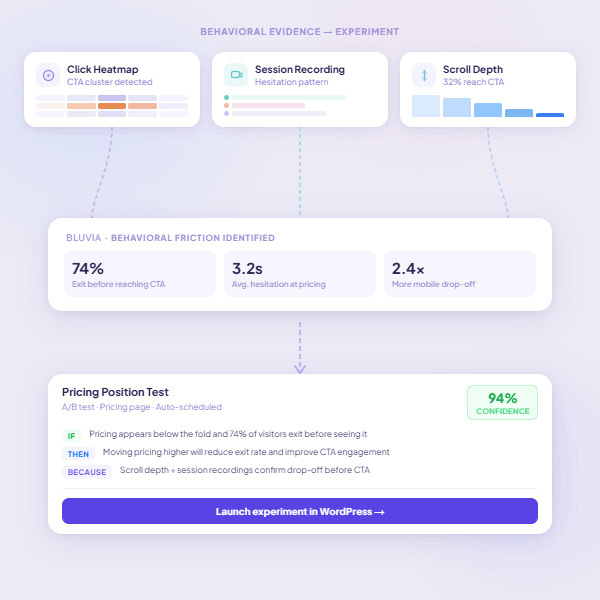
The result is a more sustainable experimentation workflow built specifically for WordPress teams that want to improve conversion performance continuously instead of relying on isolated one-time tests.
Frequently Asked Questions About Running A/B Tests
What should I test first in A/B testing?
Start with pages and elements tied directly to important conversion goals. CTAs, headlines, forms, pricing page layouts, landing page testing, and checkout flows are high-value starting points because small improvements in those areas often produce meaningful gains.
Heatmaps and session recordings also help identify which pages contain the most friction, making prioritization decisions easier.
What metrics should I track in A/B testing?
Track the primary conversion metric tied to the experiment goal, including form submissions, purchases, CTA clicks, add-to-cart actions, or engagement depth.
Also monitor visitor behavior patterns like scroll depth, session recordings, and interaction behavior across variations because behavioral insights often explain performance differences that metrics alone fail to capture.
What mistakes should I avoid in A/B testing?
The most common mistakes include:
- Testing too many variables at once
- Stopping experiments too early
- Relying on assumptions instead of behavioral evidence
- Launching large redesigns instead of focused experiments
- Treating experimentation as isolated projects instead of continuous workflows
Smaller hypothesis-driven experiments tied to clear goals usually create more sustainable optimization progress.
What are examples of A/B tests?
Common website A/B testing experiments include headline testing, CTA placement, pricing page layouts, form optimization testing, navigation structure testing, and checkout optimization. CTA testing is often one of the fastest ways to improve conversion performance on high-traffic landing page.
Other common testing examples include:
- Headline testing
- CTA testing
- Form optimization testing
- Pricing page experiments
- Navigation structure testing
- Product page layout testing
- Checkout optimization
- Landing page testing
WordPress experimentation tools like Bluvia A/B Testing also support testing themes, custom CSS, interactive elements, and full-page experiences.
How do I run A/B tests in WordPress?
The most effective WordPress experimentation workflow starts with behavioral analysis. Teams use heatmaps and session recordings to identify friction before creating hypotheses and launching focused experiments tied to measurable conversion goals.
Bluvia A/B Testing supports the full workflow directly inside WordPress without requiring external integrations or disconnected experimentation tools.
Can I run A/B tests in WordPress without a developer?
Yes. Modern WordPress experimentation tools allow marketers, agencies, ecommerce teams, and growing businesses to launch experiments without relying heavily on developer resources for every change.
Bluvia A/B Testing allows teams to test layouts, headlines, calls-to-action, forms, navigation structures, and full page experiences directly inside WordPress while managing experimentation workflows, behavioral insights, and reporting from the same platform.
How long should an A/B test run?
An A/B test should run long enough to collect meaningful data and account for normal fluctuations in visitor behavior. Stopping experiments too early is one of the most common testing mistakes because early results often change as additional data accumulates.
The appropriate duration depends on traffic volume, conversion frequency, and the amount of data required to reach statistical confidence in the outcome. High-performing experimentation teams focus on collecting sufficient evidence before declaring a winner.
Bluvia A/B Testing handles the statistical confidence calculation in the background so you know when the test has sufficient data to declare a test winner.
Build an Experimentation Program That Keeps Improving
The best experimentation teams don’t treat optimization like isolated projects. They build workflows that continuously surface better ideas, stronger hypotheses, clearer behavioral insights, and more informed testing decisions over time.
Bluvia A/B Testing helps WordPress teams connect experimentation, visitor behavior analysis, heatmaps, session recordings, and experiment management into one workflow designed for continuous experimentation and ongoing optimization.