
Understanding Visitor Behavior: What Your Visitors Are Trying to Tell You
- Rebecca Streeter
- July 29, 2026
- 8 minutes
- Visitor Behavior
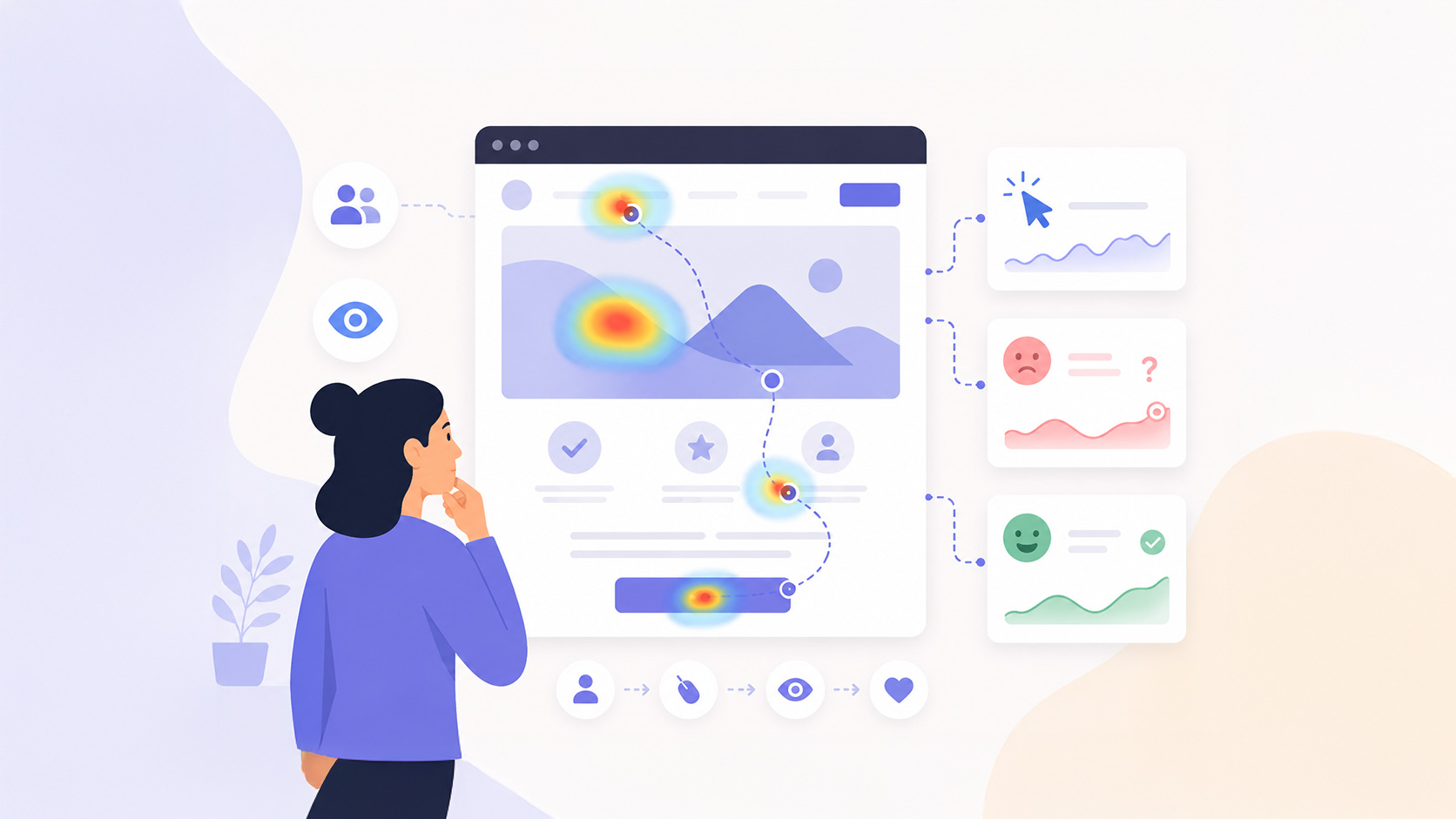
Visitor behavior provides the context that traditional analytics often lack. This article explores how organizations can move beyond traffic and conversion metrics to better understand the experiences their visitors are having. By learning to observe hesitation, confusion, and friction, teams can make more informed decisions and build more effective optimization workflows.
Most website owners know how to measure traffic.
They know how many visitors arrived yesterday. They know which campaigns generated the most clicks and which pages received the most views. Modern analytics platforms make it easy to answer those questions, and those numbers play an important role in understanding website performance.
Yet many teams eventually run into the same frustrating problem.
They know what happened, but they don’t know why.
A landing page attracts thousands of visitors but generates very few leads. A pricing page receives plenty of attention, yet visitors leave without taking the next step. A contact form is viewed hundreds of times each week, but only a small percentage of visitors complete it.
The data confirms that something isn’t working, but it rarely explains what’s getting in the way.
That’s where understanding visitor behavior becomes one of the most valuable skills an optimization team can develop. Instead of looking only at numbers, it helps you understand how real people experience your website. Every hesitation, abandoned form, unexpected click, and incomplete journey tells part of a story. Learning to recognize those patterns is often the difference between making random website changes and making improvements that genuinely improve the visitor experience.
Around the Bluvia team, we like to think of this as a simple mindset:
Listen before you optimize.
Analytics are essential for understanding website performance, but they were never designed to answer every question.
They tell you how many visitors came to your website, where they came from, which pages they viewed, and whether they converted. Those metrics help you identify where opportunities exist, but they rarely explain why visitors behaved the way they did.
Imagine opening your analytics dashboard and discovering that your pricing page has a much higher exit rate than the rest of your website. That’s valuable information because it tells you where to investigate. What it doesn’t tell you is what visitors experienced before they decided to leave.
Did they struggle to find the information they needed? Did they hesitate because pricing wasn’t clear? Did they miss an important call to action? Or did something unexpected interrupt the experience altogether?
Analytics simply can’t answer those questions on their own.
Usability expert Steve Krug has long argued that digital experiences should remove unnecessary friction rather than forcing users to work harder to accomplish their goals. That principle applies just as much to website optimization as it does to design. Before changing a page, it’s worth understanding where visitors are encountering friction in the first place. (Source: Steve Krug, Don’t Make Me Think: A Common Sense Approach to Web Usability)
This is where visitor behavior becomes so valuable.
Instead of looking only at aggregate numbers, you begin observing how individual visitors interact with your website. You watch where they hesitate, what captures their attention, what they ignore, and where they abandon the experience altogether.
Think of analytics and visitor behavior as complementary rather than competing sources of insight.
Analytics answer questions like:
Visitor behavior helps answer a different set of questions:
Neither tells the whole story on its own. Together, they provide the context needed to make smarter optimization decisions.
When you’re trying to identify friction on your website, start by looking for moments where visitors hesitate, abandon a task, repeatedly search for information, or interact with a page in unexpected ways. Those behaviors often reveal opportunities that analytics alone can’t explain.
One of the biggest mistakes optimization teams make is assuming they already know what visitors need.
A page isn’t converting well, so the headline gets rewritten. A form receives fewer submissions than expected, so fields are removed. A call to action isn’t getting enough clicks, so the button changes color.
Sometimes those ideas improve performance.
Sometimes they don’t.
The difference is rarely creativity. It’s understanding.
Imagine a product page where visitors repeatedly scroll back and forth between pricing information and the feature list before leaving the page. Without behavioral insights, it’s easy to assume the price is too high. Session recordings, however, might reveal that visitors are simply looking for clarification about what’s included before making a decision.
That’s a completely different problem, and it leads to a completely different experiment.
Instead of testing lower prices, you might test moving the feature comparison higher on the page or adding clearer explanations near the pricing section.
That’s what we mean by Listen Before You Optimize.
Rather than asking, “What should we change?” start by asking, “What are our visitors trying to tell us?“
When you begin with observation instead of assumptions, your experiments become more focused, your hypotheses become stronger, and your optimization decisions become grounded in evidence instead of opinions.
The idea is simple, but putting it into practice requires a change in how you approach optimization. Before making changes to your website, work through these four steps:
Following this process doesn’t guarantee every experiment will succeed. It does make every experiment more intentional because each decision begins with evidence instead of assumptions.
Visitor behavior is valuable because it helps you build stronger hypotheses.
Without behavioral insights, optimization often sounds like this:
“Let’s try a different headline.“
“Maybe a green button will stand out more.“
“What if we redesign the hero section?“
Those ideas aren’t necessarily wrong. They simply aren’t informed by evidence.
Now imagine approaching the same page after reviewing visitor behavior.
Analytics tell you the page converts at only 1.5%.
Session recordings show visitors repeatedly hovering over pricing information before leaving.
Heatmaps reveal that very few people scroll far enough to see the customer testimonials that build trust.
Suddenly, your next experiment becomes much more intentional.
Instead of redesigning the entire page, you might test moving testimonials higher, simplifying the pricing explanation, or making the primary call to action visible sooner in the experience.
The same principle applies to forms. Imagine visitors consistently abandoning a newsletter signup after reaching the “Company Name” field. Rather than redesigning the entire form, your first experiment might test removing that field or making it optional. Small observations like these often uncover meaningful improvements because they’re based on how people actually interact with your website, not assumptions about what they want.
Each experiment is connected to something your visitors actually did.
That’s what separates thoughtful optimization from random experimentation.
If you’d like a practical framework for turning observations into hypotheses, our How to Run A/B Tests guide walks through the process step by step.
One of the biggest misconceptions about optimization is that every improvement begins with an idea. In reality, successful optimization usually begins with observation.
The best teams notice patterns in visitor behavior, investigate where friction exists, develop thoughtful hypotheses, and validate those ideas through experimentation. Every result, whether it wins or loses, becomes another opportunity to learn something about the people using the website.
Over time, that process becomes far more valuable than any individual experiment. Rather than chasing isolated wins, organizations build a repeatable optimization workflow that continuously improves the website based on real evidence instead of assumptions.
Listen Before You Optimize isn’t just a slogan. It’s a practical approach to making better website decisions. When analytics, visitor behavior, and experimentation work together, every improvement becomes more intentional because it’s grounded in evidence rather than assumptions.
Instead of relying on opinions or isolated ideas, every improvement builds on what visitors have already taught you.
Before redesigning another page or launching your next experiment, spend a few minutes observing what your visitors are already telling you.
Ask yourself:
Those questions often uncover better optimization opportunities than brainstorming ideas around a conference table.
The goal isn’t to collect more data. It’s to better understand your visitors so you can make smarter decisions with the information you already have. When every experiment begins with evidence instead of assumptions, optimization becomes far more intentional.
Understanding your visitors is only the beginning. The real value comes from using those insights to make better decisions, build stronger hypotheses, and continuously improve the experiences you create. If you’re ready to go deeper, these resources are a great next step.

 By Bluvia Team
 By Rebecca Streeter