
Why Most A/B Tests Fail Before They Begin
- Rebecca Streeter
- July 29, 2026
- 6 minutes
- A/B Testing
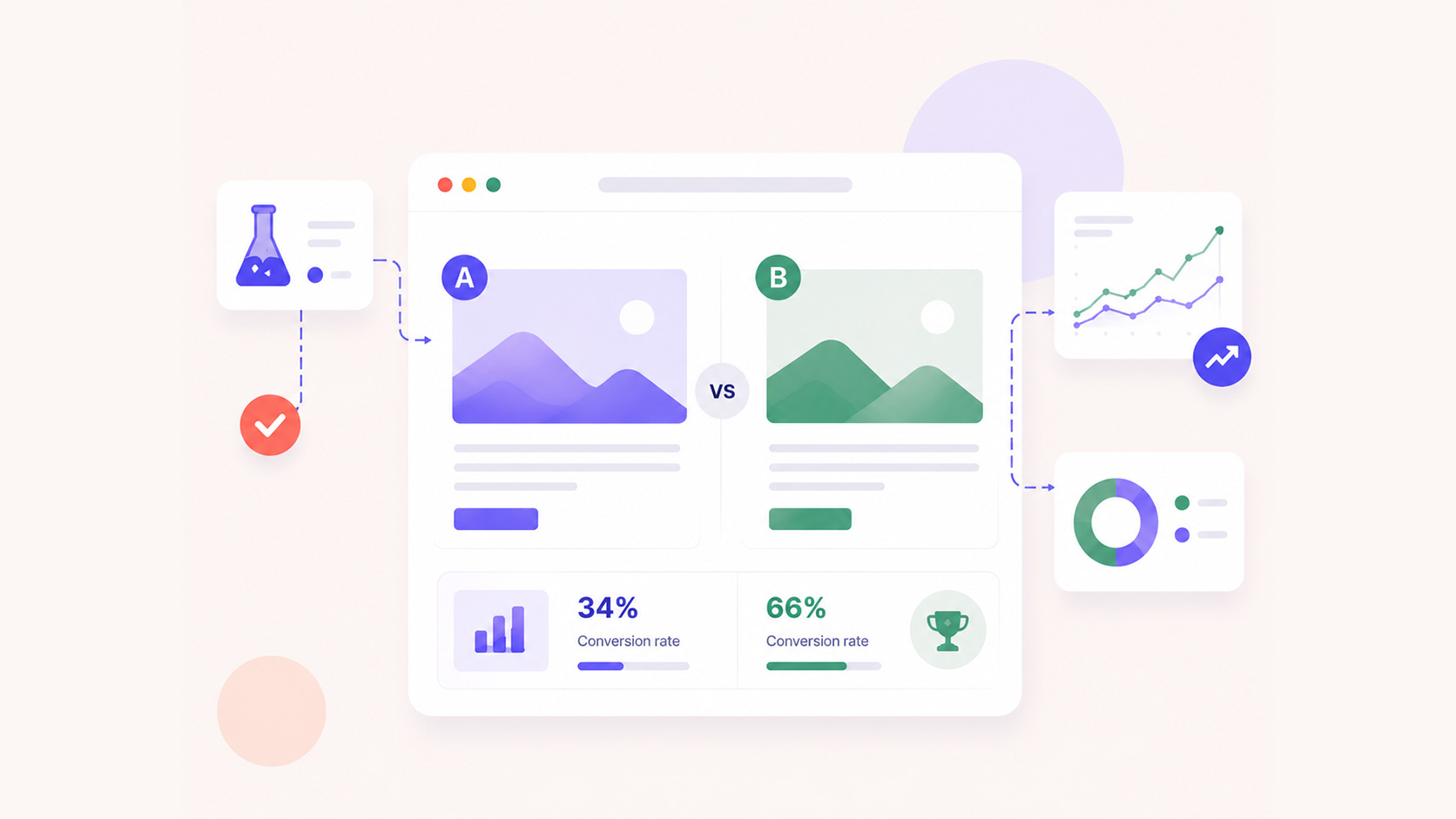
Most A/B tests fail long before anyone clicks “Launch.” Successful experimentation starts by identifying real problems, understanding visitor behavior, and developing thoughtful hypotheses. This article explains why better questions lead to better experiments and outlines the mindset and process that high-performing optimization teams use to make smarter decisions.
Most people think an A/B test begins when someone creates a variation and clicks Launch.
In reality, successful experiments start much earlier.
They begin when someone notices a problem, asks why it’s happening, and becomes curious enough to investigate before proposing a solution.
That’s where many A/B tests go wrong. Teams often jump straight to testing ideas before they’ve taken the time to understand the problem they’re trying to solve. The result isn’t just a disappointing experiment. It’s a missed opportunity to learn something meaningful about the people using the website.
If the goal of A/B testing is to make better decisions, then better decisions have to start with better questions. The quality of an experiment is rarely determined by the software you use. It’s determined by the quality of the thinking that happens before the first variation is ever created.
It’s easy to become attached to ideas. Marketing wants a new headline. Design prefers a different layout. Leadership believes a larger call to action will improve conversions. Every suggestion is usually made with good intentions, but even the strongest ideas are still assumptions until they’re tested.
Instead of asking, “What should we test?” high-performing optimization teams ask a different question:
That subtle shift changes everything. Rather than searching for something to experiment with, teams begin looking for evidence that explains why visitors struggle. Understanding visitor behavior before proposing a solution often leads to stronger hypotheses and better experiments. The experiment becomes a way to validate what they’ve learned instead of proving someone’s opinion right.
A strong A/B testing hypothesis doesn’t appear out of thin air. It grows out of observation.
Before building variations, spend time understanding how visitors interact with your website. Analytics can identify pages with unusually high exit rates or low conversions. Session recordings can reveal hesitation, confusion, or repeated actions that suggest friction. Heatmaps help visualize where visitors focus their attention and, just as importantly, what they ignore.
For example, imagine a pricing page that receives plenty of traffic but consistently underperforms. Rather than immediately testing a new headline, your research reveals that most visitors never scroll far enough to see the pricing comparison table. Suddenly the problem isn’t the headline at all. It’s that the most important information appears too late in the experience. That insight leads to a much stronger hypothesis and a much more meaningful experiment.
If you’re new to interpreting visitor behavior, our CRO Insights Guide explains how to identify friction and prioritize what to test first.
One of the easiest traps to fall into is designing experiments to confirm an existing belief.
Maybe everyone agrees that a shorter form will convert better. Perhaps the team is convinced a different hero image will increase engagement. Those ideas may ultimately prove correct, but that’s not why experiments exist.
The purpose of an A/B test isn’t to prove you’re right. It’s to discover what’s true.
Sometimes the biggest lessons come from surprisingly small changes. One of the best-known examples comes from Microsoft’s Bing search engine, where a simple experiment testing alternative advertising headlines increased revenue by 12%, representing more than $100 million in additional annual revenue in the United States alone. The experiment didn’t succeed because the team was smarter than everyone else. It succeeded because they tested an idea instead of assuming they already knew the answer.
That’s the real value of experimentation. It allows teams to replace confidence with evidence and opinions with measurable results.
Approaching experiments with curiosity instead of certainty creates better outcomes because every result becomes useful. Winning experiments improve performance. Losing experiments improve understanding.
Another common mistake is changing too many things at once.
Imagine testing a new headline, different imagery, revised copy, updated colors, and a redesigned page layout in a single experiment. If conversions improve, which change made the difference? If performance declines, which element caused the problem?
Keeping experiments focused makes the results easier to interpret and the next decision easier to make.
If you’re unsure whether an experiment is focused enough, ask yourself whether you’ll know exactly what caused the result if the test succeeds. If the answer is no, simplify the experiment before launching it.
A simple hypothesis might look like this:
“We believe making our primary call to action more prominent will increase demo requests because visitors currently overlook it on mobile devices.“
If you’d like help writing stronger hypotheses, our How to Run A/B Tests guide walks through a practical framework for planning and evaluating experiments.
Notice how specific that is. It identifies a problem, proposes a solution, and explains why the change is expected to help.
That’s a much stronger starting point than, “Let’s see if a green button works better.“
Organizations that consistently improve their websites don’t chase one winning experiment after another. They build a repeatable process for learning.
They observe visitor behavior, identify friction, develop thoughtful hypotheses, and validate ideas through experimentation before using what they’ve learned to inform the next improvement. Over time, those individual steps become a repeatable optimization workflow. Instead of relying on isolated ideas or one-time redesigns, teams build a process that helps them continuously improve their websites based on real visitor behavior.
That’s why A/B testing is far more than a feature or a marketing tactic. It’s one part of a broader optimization workflow that helps organizations replace opinions with evidence and confidence. Every experiment adds another piece of understanding, making the next decision more informed than the last.
Great experiments don’t happen because teams have better instincts alone. They happen because teams build a repeatable process for learning. Bluvia A/B Testing was designed to support that process, helping WordPress teams validate ideas, learn from every experiment, and continuously improve over time.
Before creating another variation, ask yourself these five questions:
If you can’t answer those questions clearly, you’re probably not ready to launch the experiment yet.
Building stronger experiments starts long before you click “Launch.” The more you understand your visitors, develop thoughtful hypotheses, and learn from each experiment, the more effective your optimization process becomes. These resources can help you take the next step.
When you’re ready to move from assumptions to evidence, explore Bluvia A/B Testing and discover how WordPress teams build repeatable experimentation processes that support continuous optimization.

 By Bluvia Team
 By Rebecca Streeter